
Italy Beyond the Checklist: How to Experience the Country Without the Crowds (or the Stress)
Italy Beyond the Checklist: How to Experience the Country Without the Crowds (or the Stress)
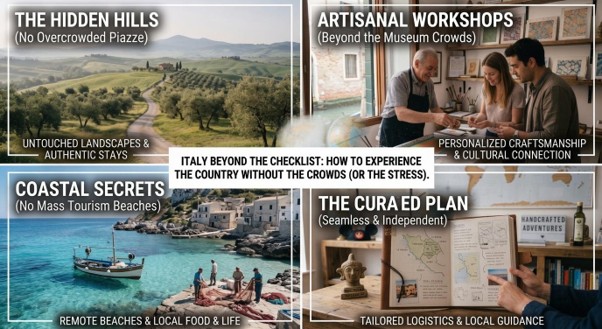
Italy is one of those destinations that almost sells itself. Rome, Florence, Venice. The Colosseum, the Duomo, a gondola at sunset. Most first-time visitors arrive with a mental checklist and leave feeling they ticked the boxes but also feeling tired, jostled, and slightly short-changed.
The good news? Italy is far bigger, quieter and more rewarding than the classic three-city loop. The difference between a stressful trip and a memorable one usually comes down to pacing, sequencing, and a handful of deliberate choices that most package itineraries never make.
Here’s how I build Italy trips that still deliver the iconic moments without the crowds or the constant sense of rushing.
Why the Classic Loop Feels Exhausting
The standard Rome–Florence–Venice itinerary packs three intense cities into 7–10 nights. Each one is spectacular. Each one is also extremely busy for much of the year. Add in train connections, hotel changes, luggage, and the pressure to “see everything,” and even enthusiastic travellers start to feel frayed by day six.
The problem isn’t the places. It’s the way most trips are structured: too many bases, too little recovery time, and almost no space for the slower, more local experiences that make Italy feel special.
A Better Framework: Icons + Breathing Space
The trips that clients rave about almost always follow a simple principle:
Keep the big moments. Protect the in-between.
That usually means:
● Fewer hotel changes
● Longer stays in each place (minimum three nights in key cities)
● At least one quieter base that isn’t on every first-timer’s list
● Private transfers or carefully timed trains on the heavier travel days
● Built-in free time so people can actually sit down and enjoy where they are
Here’s how that looks in practice.
Rome – Still Essential, Just Smarter
Rome is non-negotiable for most people, and rightly so. The key is not to treat it as a three-day sprint.
What works well:
● Four nights instead of two or three
● A well-located hotel that lets you walk to many sites but still feels calm at the end of the day
● Timed entry for the Vatican and Colosseum so you’re not standing in the longest lines
● One completely free afternoon or evening with nothing scheduled
Many clients are surprised how much better Rome feels when they stop trying to conquer it and simply live in it for a few days.
Florence & Tuscany – The Sweet Spot
Florence is beautiful and compact, but the historic centre can feel overwhelmed in peak season. The solution is rarely to skip it to use it differently.
Strong approaches:
● Two or three nights in Florence for the major sights and galleries
● Then move to a base in the countryside (Chianti, Val d’Orcia, or a quieter town such as Lucca or Montepulciano) for three or four nights
● Use the rural base for day trips, wine experiences, and simply slowing down
This rhythm city intensity followed by landscape and space is one of the most reliable ways to make Tuscany feel restorative rather than rushed.
The Coast & the South – Where the Crowds Thin Out
Once you move beyond the classic northern triangle, Italy opens up considerably.
Popular quieter alternatives I often weave in:
● Puglia – whitewashed towns, olive groves, excellent food, and a more local feel
● Sicily – dramatic, layered, and still far less crowded than the mainland highlights
● The quieter side of the Amalfi Coast or Cilento – same coastline energy, fewer day-trippers
● Lakes region (especially Lake Orta or the less-visited parts of Lake Garda) – for clients who want scenery without the full intensity of the cities
These places still feel unmistakably Italian. They just give people room to breathe.
The Small Decisions That Change Everything
Beyond the route itself, a few practical details make a noticeable difference:
● Luggage strategy – Private transfers on days with multiple train changes or hilly towns save energy and stress
● Hotel location over hotel prestige – A well-positioned three-star often beats a poorly located five-star
● Timing of key visits – Early or late entries, or simply choosing the right day of the week, can transform an experience
● One private or small-group experience – A food walk, a countryside drive, or a visit to a family-run producer often becomes the highlight
● Permission to do less – The best itineraries leave deliberate gaps. Clients who use them almost always say those were some of their favourite moments
Who This Approach Suits Best
This style of Italy works particularly well for:
● Couples who want romance and atmosphere without feeling herded
● Multi-generational families who need a mix of culture and downtime
● Travellers who have already done the classic loop and want something richer on a return visit
● Anyone who has looked at a standard 8-night Rome–Florence–Venice package and felt quietly exhausted just reading it
The Real Goal
Italy is not a checklist. It is a country that rewards people who give it time and attention. The trips that stay with clients longest are rarely the ones where they saw the most. They are the ones where they had space to notice the light on a building, the taste of a simple meal, or a conversation with someone who wasn’t trying to sell them anything.
That’s the version of Italy I prefer to build.
Thinking about Italy?
Tell me who’s travelling, how long you have, and whether you prefer cities, countryside, coast or a mix. I’ll show you a version that keeps the magic and loses most of the stress.